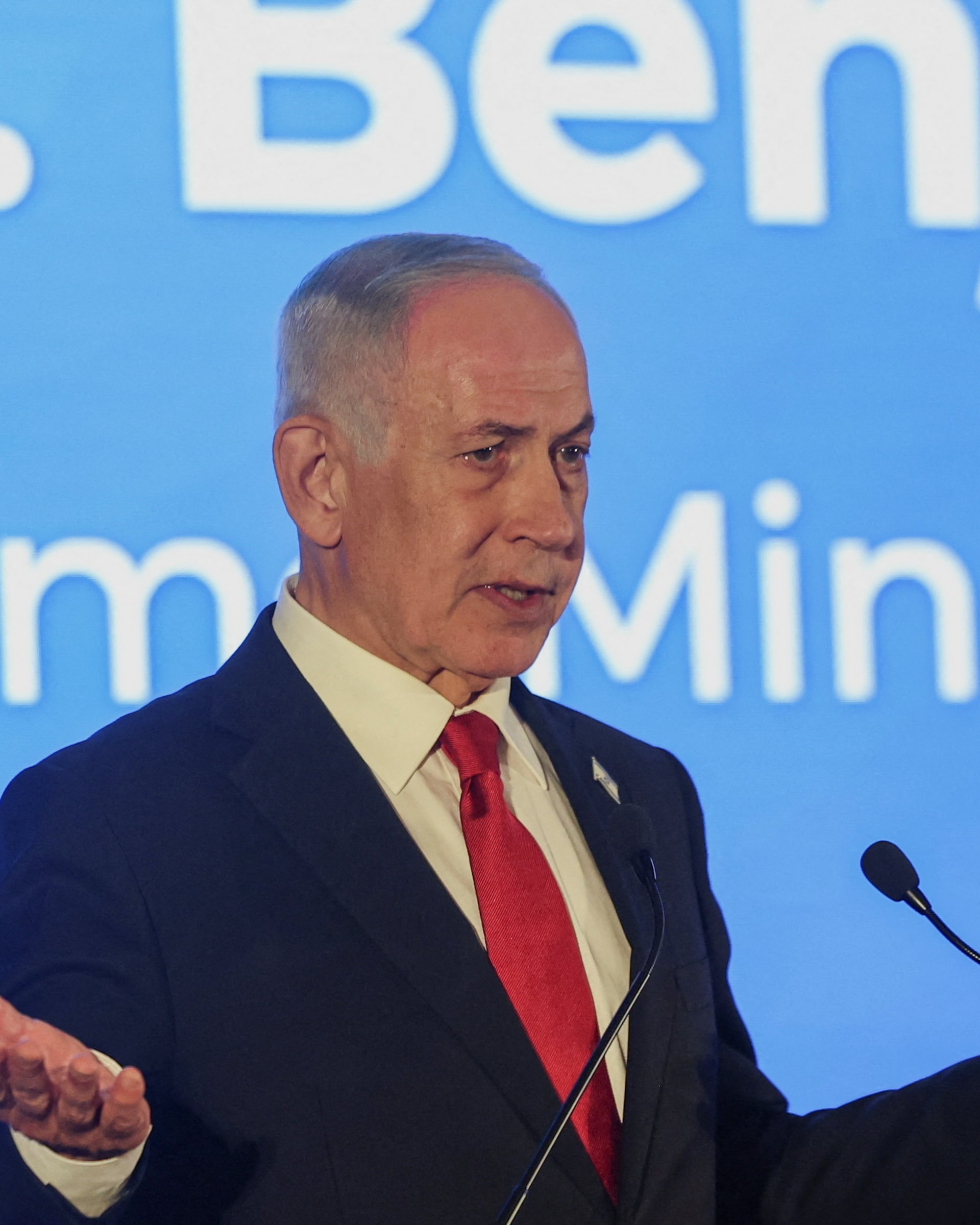
Benjamin Netanyahu is an Israeli politician who has served as the prime minister of Israel for multiple terms, making him the longest-serving prime minister in the country's history. His political career spans decades, marked by significant influence on Israeli domestic and foreign policy, particularly regarding security, economic reforms, and international diplomacy. Netanyahu's leadership has been characterized by a strong stance on national defense, a focus on free-market economics, and complex relationships with global powers, shaping Israel's trajectory in the modern era.
Quick Facts
| Full Name | Benjamin Netanyahu |
|---|---|
| Known As | Benjamin Netanyahu |
| Birth Date | October 21, 1949 |
| Age | mid-70s |
| Birthplace | Tel Aviv, Israel |
| Nationality | Israeli |
| Profession | Israeli politician, Prime Minister of Israel |
| Parents | Benzion Netanyahu (father), Cela Netanyahu (mother) |
| Partner/Fiancee | Sara Netanyahu |
| Children | Yair Netanyahu, Avner Netanyahu |
Born into a family with deep intellectual and political roots, Netanyahu's upbringing and early experiences played a crucial role in shaping his worldview and political ambitions. His career began in the military and diplomatic spheres before he transitioned into politics, where he rose to prominence through a combination of strategic acumen, public speaking skills, and a clear ideological vision. Over the years, Netanyahu has faced numerous political challenges, legal controversies, and electoral battles, yet he has maintained a central role in Israeli politics, influencing both national and international affairs.
Benjamin Netanyahu Early Life and Childhood
Benjamin Netanyahu was born on October 21, 1949, in Tel Aviv, Israel. He is currently in his mid-70s. His birthplace and early years were in a period of Israel's formation as a state, which influenced his perspectives on security and national identity. Netanyahu spent part of his childhood in the United States when his family moved there for his father's academic work, exposing him to American culture and politics from a young age. This bicultural experience contributed to his later ability to navigate international relations, particularly with the U.S. His upbringing was in a family that valued education, debate, and Zionist ideals, which played a formative role in his development.
Benjamin Netanyahu Family Life and Personal Background
Benjamin Netanyahu comes from a family with notable intellectual and political backgrounds. His father, Benzion Netanyahu, was a historian and professor who specialized in Jewish history and was a prominent figure in the Revisionist Zionist movement. His mother, Cela Netanyahu, was involved in cultural activities. Netanyahu has two brothers: Yonatan Netanyahu, who became a national hero in Israel after his death during the Entebbe raid in 1976, and Iddo Netanyahu, a radiologist and writer. The family's emphasis on scholarship, Zionism, and public service deeply influenced Netanyahu's values and career path. His brother Yonatan's legacy, in particular, had a lasting impact on his focus on military and security issues.
Benjamin Netanyahu Education
Benjamin Netanyahu attended high school in Israel and later in the United States, where he graduated from Cheltenham High School in Pennsylvania. He served in the Israel Defense Forces (IDF) from 1967 to 1972, reaching the rank of captain in an elite special forces unit, Sayeret Matkal. After his military service, Netanyahu studied at the Massachusetts Institute of Technology (MIT), earning a bachelor's degree in architecture and a master's degree in business administration from the MIT Sloan School of Management. He also completed additional studies in political science at Harvard University. His education combined technical, economic, and political disciplines, equipping him with skills he later applied in governance and policy-making.
Benjamin Netanyahu Career Beginnings
Netanyahu's career began in the military and diplomatic fields. After his IDF service, he worked in business consulting in the United States before entering public service. In the late 1970s and early 1980s, he served in various diplomatic roles, including as a deputy chief of mission at the Israeli Embassy in Washington, D.C., and as Israel's ambassador to the United Nations from 1984 to 1988. These positions allowed him to build international connections and develop expertise in foreign policy, particularly in U.S.-Israel relations. His articulate defense of Israeli interests at the UN gained him attention in Israeli political circles, setting the stage for his entry into domestic politics.
Benjamin Netanyahu Rise to Fame
Netanyahu's rise to fame in Israeli politics began in the late 1980s when he joined the Likud party and was elected to the Knesset (Israel's parliament) in 1988. He quickly gained prominence due to his media savvy, fluent English, and strong communication skills, which he used to advocate for conservative policies and national security. In 1993, he was elected chairman of the Likud party, positioning himself as a leading opposition figure. His breakthrough came in 1996 when he won the prime ministerial election, becoming Israel's youngest prime minister at that time. This victory was fueled by public concerns over security following terrorist attacks and his campaign focusing on a tough stance against terrorism and the Oslo Accords.
Benjamin Netanyahu Professional Career
Netanyahu's professional career is marked by multiple terms as prime minister and significant policy initiatives. He first served as prime minister from 1996 to 1999, during which he implemented economic liberalization policies, such as privatization and deregulation, aimed at boosting Israel's economy. His tenure also saw efforts in the peace process, including the Wye River Memorandum, though tensions with Palestinians persisted. After a period in opposition, he returned as prime minister in 2009 and served continuously until 2021, and again from 2022 onward. During these years, he focused on strengthening Israel's security through military actions, building alliances with countries like the U.S. under various administrations, and promoting technological and economic growth.
Early Career
In his early political career, Netanyahu held several ministerial positions before becoming prime minister. He served as Deputy Minister of Foreign Affairs and later as Minister of Finance from 2003 to 2005, where he advanced free-market reforms, including tax cuts and pension reforms, which contributed to economic growth. These roles helped him build a reputation as a pragmatic leader with expertise in both security and economics. His time as finance minister was particularly noted for reducing government debt and fostering a business-friendly environment, though it also faced criticism for social inequality.
Major Career Milestones
Key milestones in Netanyahu's career include his election as prime minister in 1996, his re-election in 2009 after a comeback, and his long tenure that made him Israel's longest-serving prime minister. In 2015, he secured a controversial nuclear deal with world powers regarding Iran, though he later opposed the Joint Comprehensive Plan of Action (JCPOA). He also oversaw the normalization of relations with several Arab countries through the Abraham Accords in 2020, a significant diplomatic achievement. Domestically, he pushed for judicial reforms and settlement expansions in the West Bank, which sparked political and legal debates.
Notable Performances or Projects
Notable projects under Netanyahu's leadership include the economic reforms of the early 2000s that transformed Israel into a "start-up nation" with a thriving tech sector. In security, he authorized military operations such as Operation Protective Edge in 2014 against Hamas in Gaza. Diplomatically, his speeches to the U.S. Congress in 2015 on the Iran nuclear deal and his efforts to strengthen ties with India and China expanded Israel's global footprint. His handling of the COVID-19 pandemic involved rapid vaccine procurement and lockdown measures, though it faced mixed reviews for economic and social impacts.
Later Career Developments
In later career developments, Netanyahu faced legal challenges, including indictments on charges of bribery, fraud, and breach of trust, which led to ongoing court proceedings. Despite this, he remained a dominant political figure, forming coalition governments and navigating political instability. His tenure from 2022 onward involved addressing security threats from Iran and Hezbollah, managing internal political divisions, and continuing economic policies. His legacy is intertwined with both achievements in diplomacy and economy and controversies over corruption and democratic norms.
Benjamin Netanyahu Work Style, Influence, and Public Image
Netanyahu's work style is often described as strategic, media-focused, and assertive. He is known for his effective use of communication, particularly in English, to appeal to international audiences and shape public opinion. His influence extends beyond Israel through his impact on U.S.-Israel relations and Middle East diplomacy. Public image-wise, he is viewed as a strong leader on security by supporters, while critics see him as divisive due to his hardline policies and legal issues. His ability to maintain political power despite challenges reflects his skill in coalition-building and adapting to changing political landscapes.
Benjamin Netanyahu Awards and Achievements
- Served as the longest-serving prime minister in Israeli history.
- Led economic reforms that contributed to Israel's growth as a "start-up nation" and high-tech hub.
- Facilitated the normalization of relations with Arab countries through the Abraham Accords.
- Received honorary degrees and recognitions from institutions for his contributions to diplomacy and security.
- Authored several books on terrorism and Israeli policy, influencing political discourse.
Benjamin Netanyahu Net Worth
Benjamin Netanyahu's net worth is not publicly confirmed with exact figures. Estimates vary, but it is generally considered substantial due to his long political career, book royalties, and speaking engagements. However, specific details about his assets and income are not fully disclosed, and any figures should be viewed cautiously as they are based on limited public information. His wealth has been a topic of discussion in relation to his legal cases, but no official net worth has been verified.
Benjamin Netanyahu Personal Life
Benjamin Netanyahu is married to Sara Netanyahu, a psychologist and former flight attendant. They have two sons: Yair Netanyahu and Avner Netanyahu. His personal life has occasionally been in the public eye due to media coverage of family matters and legal issues involving his wife. Netanyahu has interests in history, politics, and technology, often referencing these in his speeches. He maintains a residence in Jerusalem and is known for a lifestyle that includes official duties and private family time, though details are often kept private.
Benjamin Netanyahu Philanthropy and Community Work
There is limited public information on Benjamin Netanyahu's specific philanthropic activities or community work. While he has been involved in governmental initiatives related to social welfare and economic development as part of his political role, there are no widely documented personal philanthropy efforts or charitable foundations associated with him. Any community involvement is typically through official channels rather than private endeavors.
Benjamin Netanyahu Legacy and Influence
Benjamin Netanyahu's legacy is defined by his long tenure as prime minister and his impact on Israeli and international politics. He is credited with strengthening Israel's economy, advancing diplomatic ties with non-traditional allies, and maintaining a firm stance on national security. His influence on the Likud party and Israeli conservatism has shaped political discourse for decades. However, his legacy is also contested due to legal controversies, political polarization, and challenges to democratic institutions. Internationally, he is seen as a key figure in Middle East politics, with a lasting influence on U.S.-Israel relations and regional dynamics. His career reflects both significant achievements and ongoing debates about leadership and governance.
Frequently Asked Questions
How old is Benjamin Netanyahu?
Benjamin Netanyahu was born on October 21, 1949, and is currently in his mid-70s.
Where was Benjamin Netanyahu born?
Benjamin Netanyahu was born in Tel Aviv, Israel.
Who are Benjamin Netanyahu's parents?
His father is Benzion Netanyahu, a historian and professor, and his mother is Cela Netanyahu, who was involved in cultural activities.
Is Benjamin Netanyahu married?
Yes, Benjamin Netanyahu is married to Sara Netanyahu, a psychologist and former flight attendant.
How many children does Benjamin Netanyahu have?
Benjamin Netanyahu has two sons: Yair Netanyahu and Avner Netanyahu.
What is Benjamin Netanyahu's educational background?
He earned a bachelor's degree in architecture and a master's degree in business administration from MIT, and completed additional studies in political science at Harvard University.
When did Benjamin Netanyahu become prime minister?
He first became prime minister in 1996, making him Israel's youngest prime minister at that time.
What are some of Benjamin Netanyahu's major achievements?
He is Israel's longest-serving prime minister, led economic reforms that boosted Israel's tech sector, and facilitated the normalization of relations with Arab countries through the Abraham Accords.
What is Benjamin Netanyahu's net worth?
His net worth is not publicly confirmed with exact figures, but estimates suggest it is substantial due to his political career, book royalties, and speaking engagements.